
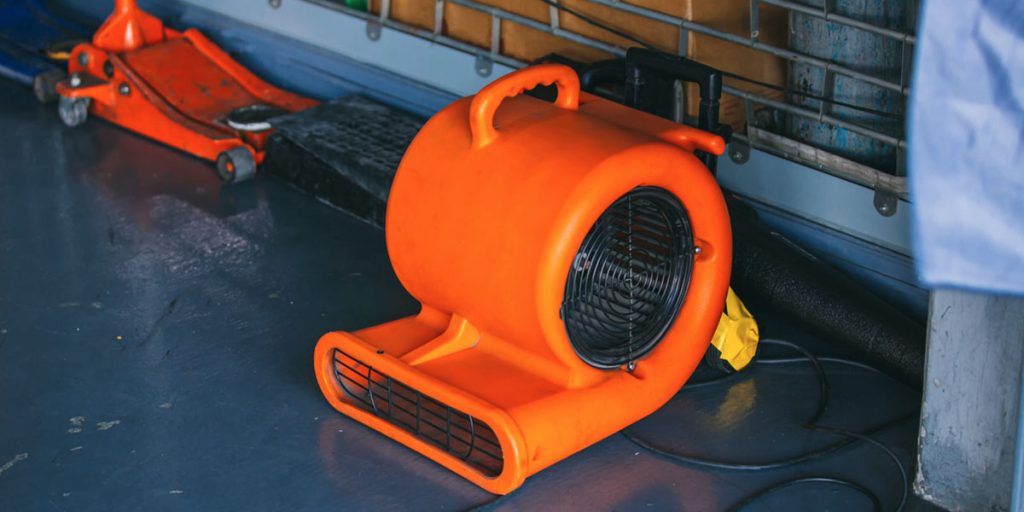
After a water leak or flood, saturated building materials become a ticking clock for secondary damage. Professional water damage restoration teams focus on creating an environment that promotes rapid, controlled evaporation, preventing structural deterioration and mold colonization that can begin within 24 to 48 hours. This process requires two distinct pieces of drying equipment working in tandem — air movers and dehumidifiers.
Air movers circulate warm air to accelerate moisture release from surfaces, while dehumidifiers extract that airborne vapor before it can recondense. Together, they transform a wet space into a verifiably dry one.
Understanding the Need for Structural Dryness
Water is invasive. Within minutes of a pipe burst or flooding event, moisture migrates beyond visible surfaces, seeping into drywall cavities, saturating subfloors, wicking up wall studs and embedding in insulation. A carpet may feel dry to the touch while the padding beneath remains waterlogged, creating the perfect environment for mold spores to colonize and structural wood to begin deteriorating.
The target of structural drying in Rhode Island isn’t about surface dryness. The term structurally dry refers to the state in which internal moisture levels in building materials like wall studs, subfloors and framing lumber return to normal readings measured with moisture meters. A room might pass a visual inspection while retaining dangerous levels of trapped moisture that won’t reveal themselves until mold appears weeks later or floorboards begin to warp.
How Trapped Moisture Leads to Mold and Rot

Hidden moisture is the primary driver of mold growth and long-term structural failure. It is critical to dry water-damaged areas and items within 24 to 48 hours to prevent mold growth. Once mold colonizes porous materials like drywall or wood framing, remediation becomes exponentially more expensive than the original water damage. Long-term exposure causes wood rot, compromises load-bearing capacity and creates indoor air quality hazards. Professional structural drying standards exist precisely to prevent these cascading failures.
Air Movers Accelerate Evaporation
Air movers, also called carpet dryers, produce high-velocity airflow directed strategically across wet surfaces such as floors, carpets and walls. Think of how wind dries clothes on a clothesline faster than still air. The moving air disrupts the thin layer of moisture-saturated air clinging to wet materials, breaking surface tension and converting liquid water into airborne water vapor through evaporation.
This distinction matters. The goal isn’t to blow water away but to change its physical state from liquid to gas. Once moisture becomes vapor, it’s suspended in the air and can be captured by dehumidifiers. Without airflow, evaporation slows dramatically and moisture remains trapped in materials, extending drying time from days to weeks and increasing mold risk exponentially.
Restoration technicians position air movers at strategic angles to create continuous airflow patterns across all affected surfaces. After professional water extraction removes standing water, air movers accelerate the evaporation phase, making hidden moisture accessible for removal.
Dehumidifiers Capture Water Vapor
Once air movers convert trapped moisture into airborne vapor, dehumidifiers complete the extraction process. These machines draw in humid, vapor-laden air from the drying environment and process it through refrigerant coils. As warm, moisture-saturated air passes over cold coils inside the dehumidifier, water vapor condenses back into liquid water.
This collected water is pumped out of the space through drainage hoses, permanently removing it from the property. Without dehumidifiers capturing that airborne moisture, the vapor recondenses on cooler surfaces like wall cavities and subfloors, restarting the saturation cycle. Low-grain refrigerant (LGR) dehumidifiers are essential for lowering the grains of moisture per pound in the air, allowing evaporation to continue efficiently even as the environment becomes drier.
Professional dehumidification services use commercial-grade equipment sized precisely for the affected area’s cubic footage and moisture load. Humidity control isn’t passive, as it requires calculating air exchange rates and continuously adjusting equipment as conditions change.
Why Correct Sizing, Placement and Containment Matter
Professional restoration isn’t about adding more fans. It’s a calculated science governed by standards set by the Institute of Inspection, Cleaning and Restoration Certification (IICRC) that determine equipment needs based on square footage, ceiling height and the class of water damage. Undersizing extends drying time and increases mold risk. Oversizing can cause secondary damage by drying materials too rapidly, leading to cracking or warping.
Calculating Equipment Needs
The IICRC S500 guidelines recommend specific air mover quantities based on affected area measurements. For floors and lower wall surfaces up to approximately 2 feet, restoration teams install one air mover for every 50 to 70 square feet of wet surface. For ceiling and upper wall areas, one air mover serves every 100 to 150 square feet. Too few air movers create “dead zones” where moisture lingers. Too many can overdry sensitive materials or waste energy without improving outcomes.
Strategic Placement
Technicians create a circular airflow pattern, sometimes called the vortex effect, by placing air movers at 5 to 45-degree angles to walls, with outlets almost touching wall surfaces and all units pointing in the same direction. This creates a continuous air circulation loop that touches every wet surface, preventing stagnant pockets where moisture can hide.
Containment
Plastic sheeting transforms large spaces into smaller drying chambers, concentrating equipment power and creating controlled microclimates. By isolating affected areas, restoration teams reduce the cubic footage equipment must process, accelerating evaporation and improving energy efficiency. Containment also prevents moisture migration into unaffected areas, limiting the damage scope.
The Role of Daily Moisture Monitoring in Structural Drying
Equipment placement and sizing only matter if technicians verify progress. Restoration isn’t set it and forget it since the drying environment changes hourly as moisture evaporates and environmental conditions shift.
During daily site visits, IICRC-certified technicians use moisture meters to measure readings deep inside building materials, not just surface moisture. These tools provide objective data showing whether materials are approaching pre-loss moisture content or still require drying time. Daily monitoring is required to provide documentation to insurance companies verifying that the property is restored to pre-loss condition.
As areas reach target dryness levels, technicians reposition air movers and dehumidifiers in RI to focus on stubborn wet spots, often concentrated in corners, behind furniture or in wall cavities with limited airflow. This adaptive approach speeds the overall restoration timeline and prevents wasted resources. Professional moisture mapping technology transforms subjective assessment into documented science, protecting both property owners and restoration contractors.
Trust Rhode Island Restoration for Water Damage Restoration in RI

Professional-grade equipment is essential, but the expertise and process behind it determine whether your property is truly restored or simply surface-dry. Rhode Island Restoration brings IICRC-certified technicians, commercial drying equipment and a methodical monitoring process to every Rhode Island water damage restoration project.
Our team doesn’t just place equipment and leave. Instead, we track moisture levels daily, adjust airflow and dehumidification as conditions change, and verify complete drying before closing your project. You can count on us for 24/7 emergency service.
Contact us today to schedule a free consultation.


