
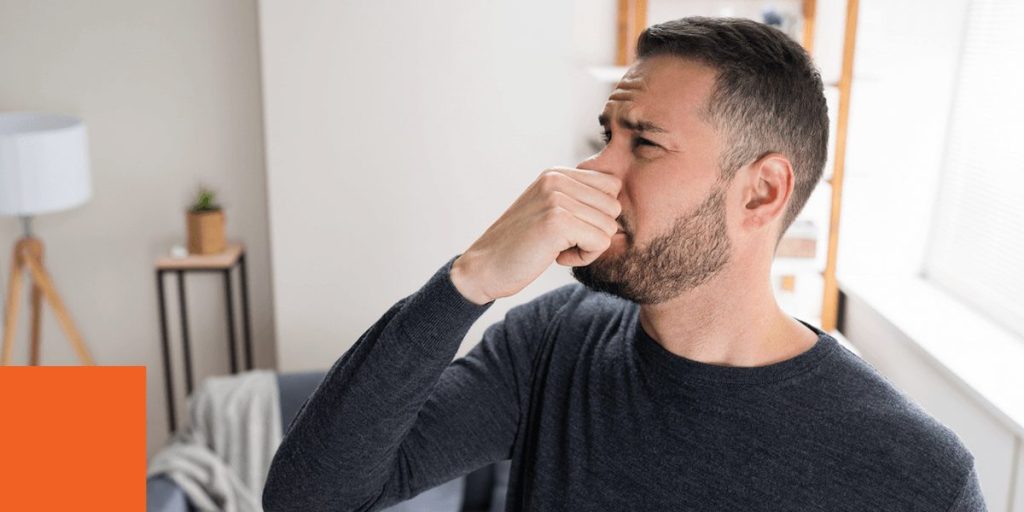
Have you noticed a persistent, musty smell after a flood? Does the odor linger even after you have cleaned and aired out the space? If so, the smell can be a warning sign that water or moisture is trapped behind walls, inside insulation or beneath floors. Without dealing with the root cause, the unpleasant odor will only get worse.
Why the Unpleasant Odor Won’t Go Away
Odor caused by water damage doesn’t go away over time. You also can’t get rid of it by covering it up, because it’s not a surface-level problem. Here are a few reasons for lingering smells:
- Microbial growth: After water damage, porous materials, such as carpet padding and drywall, absorb and hold water. This retained moisture creates the perfect environment for bacterial growth.
- Release of organic compounds: As mold and bacteria feed on these damp materials, they release volatile organic compounds (VOCs) with strong, earthy odors. These compounds are responsible for the smell of mold in your house. It could also manifest as a strong sewage-like smell.
- The rebound effect: If you don’t address the source of the moisture, the odor may disappear after basic cleaning or drying, only to return stronger than before.
Why You Must Deal With Unpleasant Odors After Water Damage
An unpleasant odor after water damage is more than a nuisance. It has several repercussions, including:
- Health implications: If you detect unpleasant odors, there is a strong likelihood that mold spores are already present and actively growing on your property. Hidden moisture creates a favorable environment for mold and mildew to thrive, exposing you to health risks, including respiratory issues and allergic reactions.
- Structural rot: A lingering smell indicates moisture, which can continue to rot subfloors, wood framing and other structural components. Over time, this can compromise your property’s structural integrity, potentially leading to costly repairs and a decrease in property value.
Our Process for Water Damage Odor Removal
Unpleasant odors caused by water damage rarely resolve on their own. You need to identify the source of the moisture and deal with it head-on with a multistep approach. At Rhode Island Restoration, we offer professional sewage backup odor cleanup and address the root cause of mold smells in your house.
We start by using thermal imaging and moisture meters to detect the hidden moisture feeding the odor — you typically can’t accurately detect moisture sources on your own without specialized equipment. Next, we perform industrial-grade water extraction to eliminate the conditions that allow bacteria and odors to thrive. To fully address microbial growth, we use EPA-registered biocides that neutralize odor-causing bacteria, ensuring a safe and clean environment. For comprehensive water damage odor removal, we use specialized equipment, including air scrubbers and thermal foggers.
As IICRC-certified contractors, our trained professionals at Rhode Island Restoration are experts at identifying the source of unpleasant odors after water damage, no matter how hidden they are. Afterward, we work to eliminate the moisture feeding them, leaving your property completely dry and with a clean, neutral scent.
Stop the Stink at the Source
You can’t deal with an unpleasant odor after water damage without addressing the source. Acting quickly limits further damage, improves indoor air quality and protects your property’s value. Prevent the damaging effects of hidden moisture. Contact Rhode Island Restoration today for professional odor removal services and eliminate the smell for good.


