
Discovering water damage in your property is more than an inconvenience. It’s a race against the clock. According to the National Flood Insurance Program (NFIP), flooding caused approximately $8.8 billion in damage in 2024, affecting thousands of homeowners and businesses.
The financial impact doesn’t stop with the initial water event. Without fast, professional intervention, water damage quickly transforms into a mold problem, bringing new health risks of mold exposure and significantly higher costs.
Learning the difference between water damage cleanup costs and the average cost of mold remediation can save you thousands of dollars. While minor water damage restoration can start at around $1,000, extensive mold remediation can cost $30,000 or more, clearly showing why early action is critical.
Water mitigation addresses the problem early, stopping damage in its tracks, while mold remediation becomes necessary for more extensive issues when moisture sits too long. This guide by Rhode Island Restoration breaks down both processes. You’ll learn what they involve, how they differ and which factors influence complexity and cost. By the end, you’ll have the knowledge to make a confident, cost-effective decision that protects both your property and your insurance claim.
Key Takeaways
- Water damage can quickly lead to mold growth if not addressed within 24-48 hours.
- Water mitigation is an immediate, less expensive response to prevent mold, often costing between $1,000 and $8,000.
- Mold remediation is a more extensive and costly process, potentially reaching $10,000-$30,000 or more.
- Rapid response to water damage is crucial to avoid mold and higher remediation expenses.
- Prompt action protects your property and strengthens your insurance claim.
- Certified professionals are essential for effective treatment, safety and insurance claim support.
How Water Damage Turns Into a Mold Problem
Water damage doesn’t stay contained to the visible puddle on your floor. It seeps into porous materials throughout your property, creating conditions that support rapid mold growth.
Understanding this progression helps property owners recognize why immediate action matters. Here’s how water damage creates mold problems:
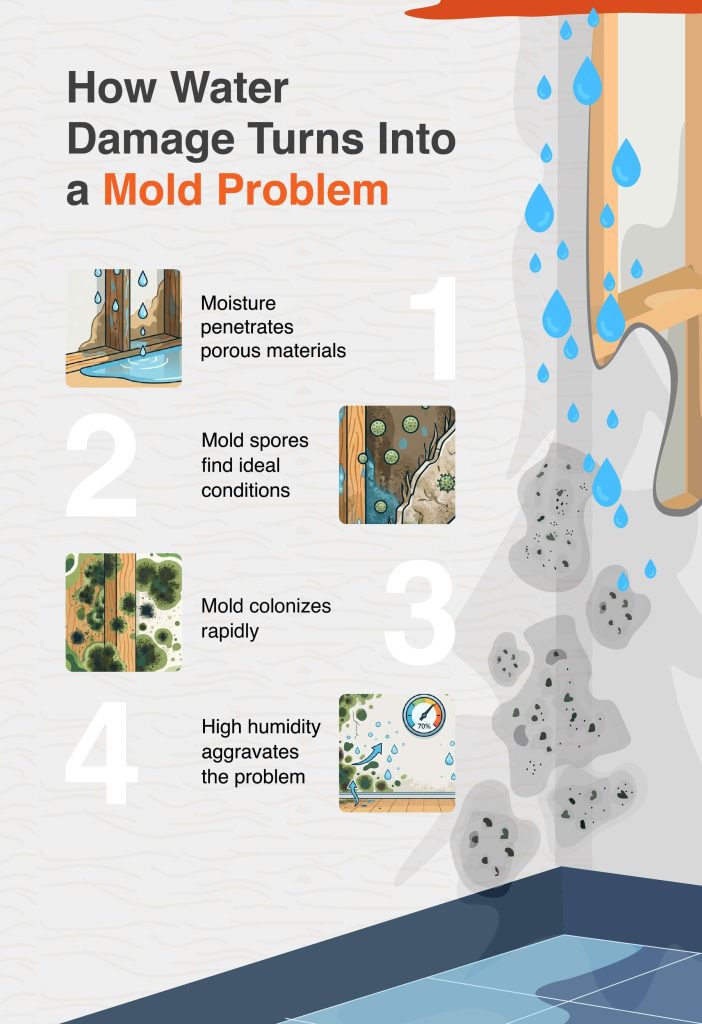
- Moisture penetrates porous materials: Water seeps into drywall, insulation, wood framing and carpet padding. These materials absorb and trap moisture, holding it deep within their structure. Even when surface water disappears, hidden moisture remains behind walls, under flooring and in ceiling cavities.
- Mold spores find ideal conditions: Mold spores exist everywhere in the environment. They’re harmless until they find moisture and a food source. Wet building materials provide both. Once mold spores settle on damp surfaces, they begin to colonize.
- Mold colonizes rapidly: Growth can begin within 24 to 48 hours of a water event. Temperature and humidity accelerate growth. Most buildings maintain conditions between 68° and 72° Fahrenheit, which is ideal for mold development.
- High humidity aggravates the problem: Humidity levels above 60% create an environment where mold thrives. This is why professional water damage restoration focuses on rapid drying and dehumidification. The goal is to remove moisture before mold takes hold.
Timing determines whether you need simple mitigation or complex remediation. Act fast and you address water damage before mold appears. Wait too long and you’re dealing with two problems instead of one.
What Is Water Damage Mitigation?
Water damage mitigation is the immediate emergency response designed to stop further damage and prevent mold growth. The primary goal is to remove standing water and dry affected materials as quickly as possible.
This is the fastest and least expensive intervention option. For a typical residential project, water damage restoration can average between $3,000 and $8,000, though minor incidents may cost as little as $1,000.
Mitigation focuses on preservation, as trained professionals use specialized equipment to dry the structure and materials before significant damage occurs. The process is systematic, documented and monitored to ensure thorough drying.
Services Included in Water Mitigation
Water mitigation involves several interconnected services, each designed to address a specific aspect of moisture removal and damage prevention:
- Emergency water extraction: Powerful pumps and vacuums remove standing water from floors, carpets and other affected surfaces. This is the first step in stopping the spread of damage.
- Moisture detection and mapping: Infrared cameras and moisture meters identify hidden water in walls, ceilings and subfloors. Technicians document moisture levels to track drying progress and ensure no areas are missed.
- Structural drying and dehumidification: Industrial air movers circulate air across wet surfaces to accelerate evaporation. Commercial dehumidifiers remove moisture from the air, preventing it from condensing on other surfaces and materials.
- Cleaning and sanitizing affected areas: After drying, technicians clean and disinfect surfaces to remove contaminants and prevent bacterial growth. This step is particularly important when dealing with contaminated water sources.
Each service builds on the previous one. Extraction reduces the volume of water. Detection ensures all moisture is located. Drying removes what extraction couldn’t reach. Sanitizing protects against secondary contamination.
Factors Influencing the Mitigation Process
Not all water damage is the same. Several variables affect how complex and time-intensive the water damage mitigation process becomes:
Extent of Damage
A small leak under a sink requires minimal intervention. A flooded basement affects multiple rooms, building systems and structural components. Larger affected areas need more equipment, more time and more comprehensive monitoring.
For example, a small-area cleanup — under 200 square feet — might cost $1,000-$2,500. However, an extensive cleanup of over 3,000 square feet can cost $10,000-$25,000+.
Water Category
Water damage is categorized by contamination level. Higher categories increase complexity and cost:
- Category 1 (clean water): From a broken supply line, posing minimal contamination risk, typically costing $1,200 to $5,500.
- Category 2 (grey water): From appliances or washing machines, containing chemical or biological contaminants, usually $2,500 to $10,000.
- Category 3 (black water): From sewage backups or flooding, requiring extensive safety protocols and disposal procedures, often $10,000 to $50,000+.
Affected Materials
Nonporous materials like tile and metal dry quickly and rarely sustain permanent damage. Porous materials like drywall, insulation and carpet absorb water deeply. Some can be saved with aggressive drying. Others must be removed and replaced, even during mitigation.
These factors determine the scope of work. A Category 1 event affecting one room looks very different from a Category 3 flood impacting an entire floor. Learning these distinctions helps property owners evaluate quotes and understand why costs vary.
What Is Mold Remediation?
Mold remediation becomes necessary when water damage wasn’t addressed quickly enough or when hidden moisture went undetected. This more intensive process focuses on safely containing and removing contamination, using specialized techniques like containment barriers, negative air pressure systems and careful disposal of contaminated materials.
Property owners quickly see why early intervention matters when comparing costs — remediation is significantly more expensive, requiring extensive safety protocols, specialized equipment and necessary reconstruction.
It’s also important to factor in the initial cost of mold inspection, as this professional assessment guides the entire remediation strategy.
Services Included in Mold Remediation
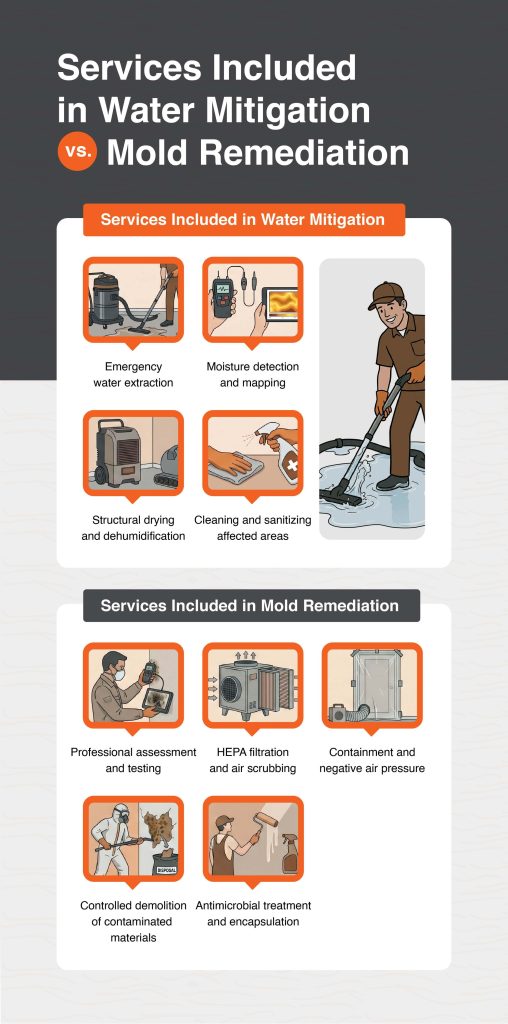
Mold remediation is a multistage process that goes far beyond simple cleaning. Each service addresses a specific aspect of safe mold removal:
- Professional assessment and testing: Certified inspectors evaluate the property to locate all mold, including hidden colonies, using air quality tests and surface samples to identify types and concentrations. Understanding the cost of mold testing provides clarity for this crucial step, which shapes the remediation plan and establishes baseline conditions for post-remediation verification. Mold assessment alone typically costs $300 to $700.
- HEPA filtration and air scrubbing: High-efficiency particulate air (HEPA) filters capture microscopic mold spores from the air. Air scrubbers run continuously during remediation to maintain air quality and reduce airborne contamination.
- Containment and negative air pressure: Physical barriers seal off affected areas to prevent cross-contamination. Negative air machines create lower air pressure inside the containment zone, so air flows in rather than out. This keeps spores from spreading to clean areas during removal.
- Controlled demolition of contaminated materials: Porous materials with heavy mold growth cannot be cleaned effectively. Technicians carefully remove and bag drywall, insulation, flooring and other affected materials. Controlled demolition minimizes spore release during the process.
- Antimicrobial treatment and encapsulation: After removing contaminated materials, technicians treat the remaining surfaces with antimicrobial solutions and apply encapsulation. Encapsulants seal porous surfaces to prevent future mold growth and lock in any residual spores.
These services work together to eliminate mold safely and prevent recurrence. The professional mold remediation process follows established guidelines to protect occupants and workers.
Factors That Complicate Remediation
Several variables make mold remediation more complex and time-consuming than water mitigation:
- Health and safety risks: Mold exposure can cause allergic reactions, respiratory issues and other health problems. Technicians wear personal protective equipment (PPE), including respirators, gloves and protective suits. The work area must be isolated to protect occupants from airborne spores during removal.
- Cross-contamination prevention: Without proper containment, demolition and cleaning activities spread spores throughout the property. Professional remediation requires extensive setup to create barriers, maintain negative air pressure and establish decontamination zones. This infrastructure adds time and cost to the project.
- Location of mold: Accessible areas, such as walls and ceilings, are easier to address. However, mold in HVAC systems, attics and crawl spaces requires specialized access and ventilation due to unique challenges, which significantly impact the approach. For example, remediation for a small area (under 10 square feet) typically costs $500-$1,500, while a full-house remediation can cost $10,000-$30,000+.
These complications explain why following appropriate remediation guidelines matters. Cutting corners or attempting DIY removal often spreads contamination and creates bigger problems. Professional remediation addresses the issue comprehensively the first time.
Water Mitigation vs. Mold Remediation
Learning the distinctions between water mitigation and mold remediation helps property owners recognize which service they need and why costs vary so dramatically.
Equipment and Safety Needs
Water mitigation focuses on removing water and monitoring moisture levels. Technicians use drying equipment such as air movers, dehumidifiers, moisture meters and extraction units. Safety concerns are minimal for Category 1 water events. Higher water categories require some protective equipment, but the primary challenge is drying, not contamination.
Mold remediation requires containment and filtration equipment. Negative air machines, HEPA air scrubbers and physical barriers become essential. Technicians wear respirators and protective suits to avoid exposure to spores. The setup alone takes significantly more time than starting a mitigation project. Every precaution is taken to prevent contamination during the removal process.
The equipment difference directly impacts project costs. Mitigation equipment is widely available and less specialized. Remediation equipment is more expensive to purchase and operate. It requires trained technicians who understand proper containment protocols and safety procedures.
Material Scopes
Mitigation aims to save materials by drying them before permanent damage occurs. Hardwood floors, drywall and insulation can often be preserved if dried within 48 to 72 hours. The goal is to restore the property to its pre-loss condition with minimal demolition and reconstruction.
Remediation often requires removing and discarding contaminated materials. Porous materials with mold growth rarely return to safe conditions through cleaning alone. Drywall gets torn out. Insulation is bagged and properly disposed of. Carpet and padding go to the landfill.
After removal, the property needs reconstruction. This increases costs beyond the remediation itself.
Project Timelines
Mitigation can often be completed in three to five days for straightforward projects. Technicians extract water on day one, set up drying equipment and monitor moisture levels daily. Once materials reach acceptable moisture content, equipment is removed and final cleaning begins. The timeline depends on the extent of damage, but the process generally moves quickly.
Remediation is a multistage process that takes longer. Assessment and testing happen first, followed by containment setup. Demolition and removal come next. Air scrubbing and treatment continue for several days.
Post-remediation testing verifies the work, then reconstruction begins. From start to finish, remediation projects often take two to three weeks or more. Complexity extends the timeline because every step requires careful execution to ensure safety and effectiveness.
Overall Cost Difference
Ultimately, these distinctions translate to significant cost differences. A typical water damage restoration project, averaging $3,000-$8,000, is often much less expensive than mold remediation.
While mold remediation can average $3,000-$7,500, it can easily reach $10,000-$30,000+ for larger issues requiring extensive material removal and reconstruction.
Make an Informed and Cost-Effective Decision
The most significant factor in managing cost and complexity is response time. Water damage that’s addressed immediately stays manageable. Water damage that sits for days becomes a mold problem.
Understanding this relationship empowers property owners to act decisively when water intrusion occurs.
Why You Should Hire Certified Professionals
Professional restoration technicians bring expertise and equipment that DIY approaches cannot match. Attempting to handle water damage or mold issues without proper training creates risks that often cost more to fix than hiring professionals from the start.
Here’s why certified professionals are essential:
- Moisture detection prevents hidden problems: Without calibrated moisture meters and infrared cameras, hidden water goes unnoticed. It sits in wall cavities, under flooring and in insulation. Weeks later, mold appears. Professional technicians detect moisture you cannot see.
- IICRC certification ensures proper training: Certified technicians understand water damage restoration, structural drying and mold remediation. They know how long different materials take to dry under specific conditions. They follow established protocols that prevent problems during the restoration process.
- Documentation supports insurance claims: Professionals document every step of the mitigation or remediation process. This documentation proves you acted responsibly and supports your insurance claim. DIY efforts rarely include the detailed records insurance companies require.
- Safety protocols protect occupants and workers: Mold remediation without proper containment spreads spores throughout the property. Inadequate protective equipment exposes people to health hazards. Professional remediation follows safety standards that protect everyone involved.
Certified professionals get the work done right the first time. Attempting DIY restoration to save money often results in incomplete drying, hidden mold growth and failed insurance claims that cost far more than professional intervention would have.
How Acting Fast Protects Your Insurance Claim
Insurance coverage for water damage and mold depends heavily on how quickly you respond to the initial water event. Understanding this connection helps property owners make decisions that protect both their property and their financial interests.
Fast action protects your insurance claim in several critical ways:
- Shows reasonable mitigation efforts: Most insurance policies cover sudden and accidental water damage, but they expect property owners to act reasonably to prevent further damage. Failing to mitigate the initial water damage can jeopardize coverage. Insurance companies may deny or reduce claims if they determine that you unreasonably delayed mitigation.
- Proves responsible action: Professional mitigation creates a clear timeline and documentation trail. It shows you took steps to minimize damage and protect your investment. This evidence supports your claim and demonstrates that you met your policy obligations.
- Avoids mold claim complications: When insurance covers the water damage, prompt mitigation prevents mold from developing. The claim stays focused on water damage restoration. Mold claims are more complex and often subject to sublimits or exclusions. Prevention through fast mitigation keeps your claim straightforward.
- Strengthens claim approval: Insurance adjusters view fast mitigation favorably. It demonstrates responsible property management and reduces the insurer’s total payout. This often leads to smoother claim processing and faster approval.
Your insurance policy is an asset that protects your property investment, but that protection depends on your actions after damage occurs. Immediate professional mitigation demonstrates you’re meeting your policy obligations and taking reasonable steps to prevent further loss.
Protect Your Property and Investment
The difference between water damage mitigation and mold remediation comes down to timing. Act within the first 24 to 48 hours and you can often avoid mold growth entirely. This keeps costs lower and protects your property from extensive damage.
Wait too long and moisture creates the ideal conditions for mold. What could have been a straightforward drying project becomes a complex remediation process involving containment, removal and reconstruction.
Your insurance coverage also depends on your response time. Most policies expect property owners to take reasonable steps to prevent further damage after a water event. Fast mitigation demonstrates that you acted responsibly, strengthens your claim and protects your eligibility for coverage.
When water damage occurs, contact IICRC-certified restoration professionals immediately. They can assess the situation, explain your options and begin mitigation before mold sets in.
Disclaimer: Please note that all cost figures provided in this guide are estimates based on national averages and current industry data. Actual water damage restoration and mold remediation costs can vary significantly due to factors such as location and project complexity.
For an accurate assessment and personalized quote, always consult with a certified professional.


