
Does your property have a persistent, musty smell that lingers even after cleaning? Are you or your loved ones coughing for no reason? These signs could mean there’s mold growing somewhere you can’t see. Mold flourishes in humid, undisturbed spaces, staying unnoticed until it causes property damage or health risks.
If you suspect a mold problem but don’t know where to look, we’re here to help. Learn the warning signs, common places that mold likes to hide and what you can do about it.
Why Does Mold Grow Undetected?
Mold is a type of fungus that survives on dead or decaying organic matter. It thrives in dark, hidden places that aren’t often inspected, such as under floors or behind walls. The fungus breaks down everything from wood and drywall to pet dander and dust as a food source.
Since it starts as microscopic spores, mold spreads unnoticed in concealed spots before becoming visible. By the time you see or smell mold, it’s already established a colony.
Consequences of Ignoring Hidden Mold
The risks of overlooking a mold problem include:
- Property damage: Mold feeds on the organic material that holds your house together, compromising structural integrity.
- Escalating costs: Localized mold patches can turn into large, expensive remediation projects. Waiting can multiply your repair expenses.
- Health risks: Prolonged exposure can cause adverse reactions, especially in kids, older adults and other vulnerable individuals.
- Reduced property value: A history of unresolved or severe mold can decrease property value and deter potential buyers.
- Liability and fines: For commercial property owners and landlords, ignoring mold can lead to lawsuits, code violations and skyrocketing insurance premiums.
Hidden Mold Warning Signs
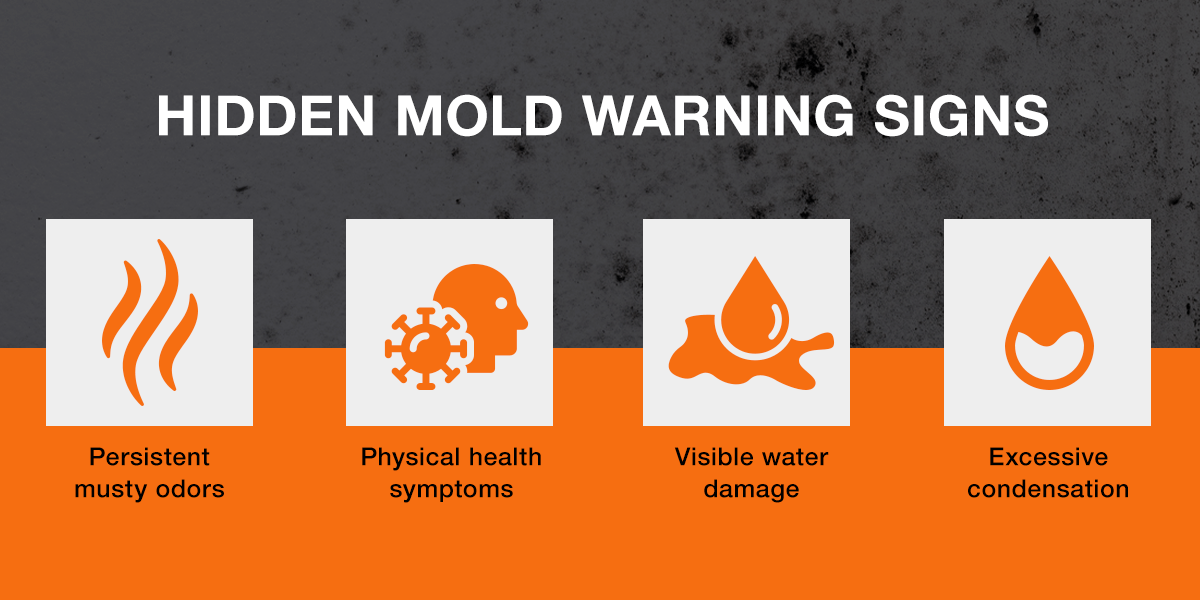
While you might not be able to see concealed mold, it does leave clues. Pay attention to these four warning signs:
- Persistent musty odors: A lingering earthy or damp smell is often the earliest sign of hidden mold. The smells may get stronger when you turn on the HVAC system or in a specific room.
- Physical health symptoms: Mold spores circulating in the air can cause allergies and respiratory issues. Indications include chronic sneezing, coughing, itchy eyes, headaches or sinus congestion. If symptoms improve after leaving the house, mold could be to blame.
- Visible water damage: When flooding, a burst pipe or a leak causes water damage, mold often follows. Look for bubbling, peeling, or cracking paint and wallpaper. You should also check for warped floorboards or soft, spongy drywall.
- Excessive condensation: Foggy windows and moisture accumulating on walls or pipes indicate high indoor humidity.
If you notice these red flags, contact a mold remediation professional to arrange an inspection.
Top 6 Most Common Hiding Spots for Mold
Finding hidden mold becomes easier when you know where to look. Keep an eye out for growth in these common hot spots.
1. In Attics and Crawl Spaces
Moisture in attics and crawl spaces creates the perfect environment for hidden mold. In attics, moisture comes from trapped heat and humidity — often caused by poor ventilation or roof leaks. In crawl spaces, the source may be poor drainage, open vents, plumbing leaks or water evaporating from the soil.
To prevent mold in these areas, it’s important to seal air leaks, ensure proper ventilation, encapsulate crawl spaces, and fix drainage or leaks promptly.
2. Behind Drywall and Wallpaper
Drywall and wallpaper create traps for moisture. The problem often starts with a concealed pipe leak or excessive humidity.
Once wet, paper backing becomes a perfect food source for mold spores. Dark, enclosed wall cavities provide an incubator for hidden mold to spread until it starts affecting the surface. Bubbling, discolored wallpaper or spongy drywall are telltale signs to look for.
While specialized cleaners can sometimes resolve surface mold, deeper issues require replacement of the affected materials.
3. Inside Your HVAC System and Air Ducts
Condensation is a major contributor to mold in HVAC systems. When warm, humid air meets cooler surfaces inside ducts or coils, water droplets form. Spores land in the damp environment, feeding on the dust, debris and skin cells that accumulate inside the system. Mold in air ducts then circulates through your home. Left unchecked, it can spread musty odors and affect indoor air quality.
Take preventive steps by changing filters, checking AC condensation drain lines for clogs, and controlling humidity with a dehumidifier.
4. On or In Basement Walls
Damp, cool basement walls are prime real estate for mold. Groundwater enters through cracks or porous concrete foundations. Most basements have higher-than-average humidity levels combined with poor ventilation. Any organic material on the walls, like drywall paper or wood, provides a food source for mold spores.
Keep humidity levels between 30% and 50% to prevent mold in basement walls. It helps to run a dehumidifier, seal any visible foundation cracks and improve ventilation inside the space with fans.
5. Under Flooring
Beneath your flooring materials lies a dark, undisturbed environment that can trap water. Sources include plumbing leaks, spills seeping through gaps or humidity condensing on a cool subfloor. The floor covering acts like a lid, preventing evaporation and drying.
The signs of mold here can vary based on the flooring material:
- Mold under vinyl flooring: Your floor might feel soft or spongy in some spots. Check for dark, fuzzy patches along plank edges or yellowish water stains. The indicators are the same for mold under laminate flooring.
- Mold under hardwood floors: When hardwood floors absorb water, the planks swell. The edges may curve upward, or the boards may lift off the subfloor.
- Mold under laminate flooring: Laminate is a wood-composite material, so it absorbs moisture. Look for cupping, crowning or bulging floorboards. A peeling, bubbling top layer is also a telltale sign.
If you notice any of the above, the next step is to address the source of the moisture. Replacing moldy flooring and underlying padding may be the best solution, especially for hardwood or carpet. Use a high-quality vapor barrier when installing new floors to avoid future mold issues.
6. Behind Shower Tiles
Mold behind shower tiles signals a failure in the wall’s waterproofing. Cracked grout, deteriorating caulk or improper tile installation can allow water to seep behind the tile. When that happens, mold tends to grow on the porous backing materials, like drywall or backer board. Surface sprays often fail to get rid of the problem, making a complete tear-out and mitigation necessary.
If you suspect mold, stop using the shower until you fix the cause of water intrusion. Active mold spreading into wall cavities requires professional remediation to treat the area without spreading spores. When rebuilding, install a waterproof membrane to prevent leaks.
Why Professional Mold Inspection With Moisture Mapping Is Crucial
Since mold lurks in concealed spaces, it’s hard to see with the naked eye. Remediators use a moisture mapping process to identify, measure and visualize invisible, trapped water. They use specialized diagnostic tools to scan your property. Thermal imaging cameras detect temperature drops behind walls caused by evaporating water. Moisture meters measure the saturation levels of materials like drywall or wood. This process guides your mitigation plan. It tells contractors which materials they can dry out and which need removal to prevent ongoing mold growth.
How Rhode Island Restoration Finds and Mitigates Hidden Mold
No matter how well mold hides, the certified technicians at Rhode Island Restoration can find it. We’ve restored safety to residential and commercial properties since 2002.
Here’s what you can expect from our reliable mold remediation process:
- Assessment: We start with a detailed visual inspection to identify visible clues. Then, we use specialized equipment to detect water sources in walls, floors, basements and other spaces. Our technicians may also measure the amount of mold spores in the air.
- Isolation: Agitating the mold spores during removal causes them to spread. We use precautions like HEPA-filtered negative air machines and physical barriers to isolate the mold. This step ensures we contain the spores to the affected area.
- Removal and cleaning: Our team removes porous materials with deep-embedded mold. Hard, nonporous surfaces get HEPA vacuumed and scrubbed with specialized cleaning agents to eliminate the mold. We apply an antimicrobial coating to cleaned materials to prevent future infestations.
- Air purification: After drying, our contractors use HEPA-filtered air scrubbers to filter air in the affected space. This process may take days, repeating as many times as necessary to trap as many spores as possible.
- Follow-up inspection: After remediation, we use a three-step strategy of visual inspection, moisture content evaluation and air sampling. The results of this inspection determine if the treated area is safe.
- Reconstruction: At this stage, you can start the process of rebuilding or repairing any damage. Rhode Island Restoration is a licensed general contractor. As part of our complete restoration construction services, we can assist with fair estimates, insurance documentation, permits and high-quality repairs.
Schedule Your Free Consultation Today
Take the guesswork out of finding hidden mold in your property. The licensed, insured and certified team at Rhode Island Restoration knows exactly where to look. With swift, 24/7 emergency service, we’re the on-call crew you can count on. Your peace of mind is our top priority. We earn it through proven expertise, reliable results and a dedication to 100% satisfaction.
A safer home or business starts with a single call. Dial 401-834-3473 for immediate assistance or request your free consultation online.


